The exact conversion is simple: °C = (°F − 32) × 5 ÷ 9. What bakers actually need, though, is not the formula but the landing spots — the dozen temperatures that cover nearly every recipe ever printed, in every scale at once, with the fan setting and the old descriptive name alongside. Here they are:
| Fahrenheit | Celsius | Fan oven | Gas mark | Oven heat |
|---|---|---|---|---|
| 225 °F | 110 °C | 90 °C | Gas ¼ | Very slow |
| 250 °F | 120 °C | 100 °C | Gas ½ | Very slow |
| 275 °F | 140 °C | 120 °C | Gas 1 | Slow |
| 300 °F | 150 °C | 130 °C | Gas 2 | Slow |
| 325 °F | 165 °C | 145 °C | Gas 3 | Moderately slow |
| 350 °F | 175 °C | 155 °C | Gas 4 | Moderate |
| 375 °F | 190 °C | 170 °C | Gas 5 | Moderately hot |
| 400 °F | 200 °C | 180 °C | Gas 6 | Hot |
| 425 °F | 220 °C | 200 °C | Gas 7 | Hot |
| 450 °F | 230 °C | 210 °C | Gas 8 | Very hot |
| 475 °F | 245 °C | 225 °C | Gas 9 | Very hot |
| 500 °F | 260 °C | 240 °C | Gas 10 | Very hot |
Reading the chart like a baker
Fahrenheit is the scale of American recipes, and its baking range is narrow: almost everything you will ever bake sits between 300 °F and 475 °F. Celsius figures in charts are rounded to the nearest 5 degrees, because oven dials cannot hold 176.7 °C and do not need to — 350 °F is exactly 176.7 °C, the chart says 175 °C, and your cake will never know the difference. Gas marks are the British dial scale: each full mark is worth roughly 25 °F (about 14 °C), starting from gas mark 1 at 275 °F / 140 °C. Half marks exist on older dials for the temperatures in between.
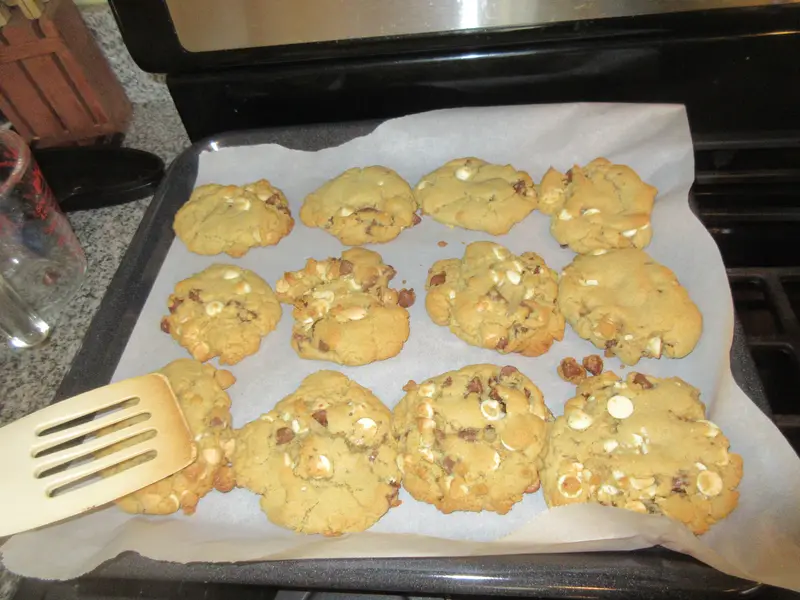
The fan-oven rule, and when it bends
Fan (convection) ovens blow hot air continuously, so food heats faster and surfaces brown sooner. The standing rule: set a fan oven about 20 °C below the conventional Celsius temperature — so a cake written for 175 °C conventional bakes at roughly 155 °C fan. Three qualifications keep the rule honest. First, some manufacturers calibrate for a 10 °C reduction instead; the manual for your specific oven outranks any chart. Second, the fan's real advantage is evenness across shelves, not speed — timings shrink only slightly, so check doneness by the recipe's cues, not the clock. Third, delicate bakes that rely on still air and steam — meringues, some soufflés, crusty breads baked in the open — are often better on a conventional setting if your oven offers one.
Words instead of numbers: the old oven scale
Pre-thermostat recipes describe ovens by feel, and the vocabulary was standardised enough to translate: a very slow oven is 225–250 °F (110–120 °C) — meringues and drying; slow, 275–300 °F — rich fruit cakes and slow roasts; moderately slow, 325 °F — many sponge cakes; moderate, 350–375 °F — the default cake and cookie range; moderately hot, 400 °F — pastry and scones; hot, 425–450 °F — breads and pizza bases; very hot, 475–500 °F — pizza, flatbreads and finishing. If a vintage recipe says “a quick oven”, read it as moderately hot to hot, around 400–425 °F.
Your oven is probably lying to you
Domestic oven dials are routinely off by 10–25 °C, in either direction, and the drift grows as thermostats age. The symptoms are diagnostic: cakes that dome and crack (too hot), bakes that sink in the middle (too cool to set before the rise collapses), pale tops with dark bottoms (heat distribution, often a fan or shelf-position issue). The cure costs very little: an oven thermometer that lives permanently on the middle rack. One bake with it tells you your oven's personal offset; write the correction on a note by the dial — “runs 15 hot” — and every chart, including this one, becomes accurate again. The temperature converter in the app handles the scale maths; the thermometer handles the truth.
Baking at altitude: when the chart needs help
Above roughly 3,000 feet (900 m), lower air pressure changes the physics the chart assumes. Leavening gases expand more easily, so cakes rise fast and then collapse; moisture evaporates faster, drying bakes out; and structures set more slowly. The standard adjustments published by high-altitude extension services work as a package: raise the oven temperature by 15–25 °F (about 10–15 °C) so the crumb sets before the over-eager rise outruns it, trim each teaspoon of baking powder or soda by an eighth to a quarter, cut sugar slightly, and add a spoonful or two of extra liquid. Apply them one bake at a time and keep notes — altitude baking is a local science, and your kitchen's altitude, flour and oven combine in ways no chart can fully predict.
Preheating, hot spots and other dial realities
Three habits separate the temperature on the recipe from the temperature in the food. Preheat fully, then wait a little longer: most ovens announce readiness when the air first touches the target, while the walls — which radiate most of the heat that actually bakes — still lag behind; an extra ten minutes makes the first tray behave like the second. Know your hot spots: bake a layer of white bread slices wall to wall once, and the toast pattern maps your oven's hot and cool zones permanently; rotate trays halfway through if the map is uneven. Mind the shelf: the middle rack is the default for a reason — top shelves brown faster under the element, bottom shelves crisp bases and burn bottoms. None of this appears in any conversion table, and all of it matters more than the difference between 175 °C and 177 °C. Convert the number correctly, then bake by the cues: colour, spring, and the skewer never lie.